Recruitment most often breaks down at the “from intent to onboarding” stage: interview evaluations are conducted in chat, offers are drafted in email, and background checks and document lists are tracked in separate spreadsheets. Candidates experience repeatedly being urged to submit materials; HR faces the challenge of onboarding day systems still not having accounts set up. Resumes, interviews, offers, and onboarding— if these four stages don’t share the same candidate ID, coordination costs rise exponentially.

Treat candidates as a continuous thread throughout the process.
- Resume ingestion and deduplication (by phone number/email/ID)
- Interview planning and scoring rubrics (with fixed dimensions to avoid purely subjective one-sentence assessments)
- Offer approvals: job level, salary range, start date, and headcount allocation
- Onboarding tasks: contracts, medical exams, system accounts, equipment, training
Spreadsheets can track progress but cannot guarantee it. Headcount and offers must align closely—otherwise, overstaffing leads to wasted positions, and finance and business end up arguing afterward.
DesignHiring managers view candidates within their own department; HRBPs drive processes; recruitment specialists manage channels; salary ranges are displayed to hiring managers as bands. Interviewers can only rate their own rounds and cannot alter others’ scores.
- Job roles and headcount: total count, used, frozen
- Candidates: stage, source, deduplication key
- Interview evaluations: dimension scores, conclusions, conflict-of-interest statements
- Offer letters: version, approval chain, acceptance/rejection status
- Onboarding checklists: task owners, deadlines, proof of completion
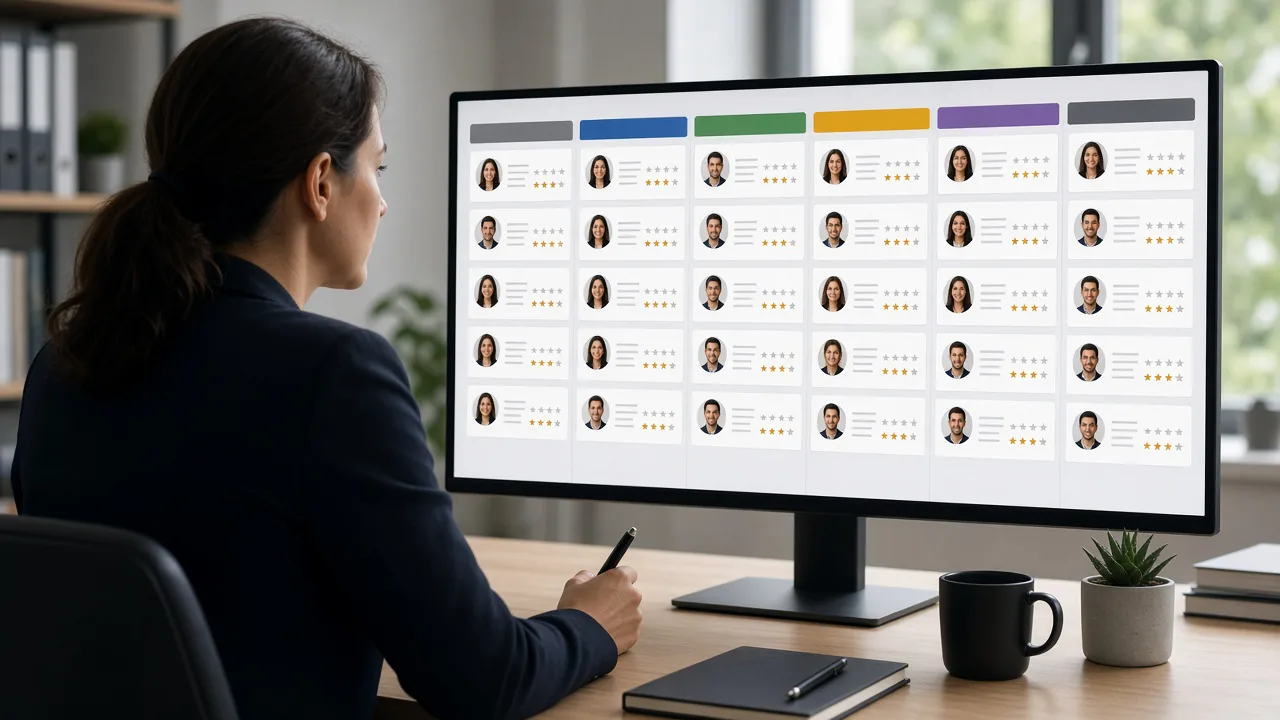
Key implementation points
After an offer is accepted, headcount is automatically allocated and the onboarding project template triggers (IT sets up accounts, administration prepares workstations). If a candidate declines or withdraws, headcount is released. Background checks that fail prevent contract signing. If interviewers miss deadlines, reminders are sent automatically; two missed deadlines escalate to HRBP oversight.
Acceptance criteria: whether multiple channel submissions for the same candidate should be merged; whether offers exceeding headcount limits should be blocked; whether work permits can be issued if onboarding tasks aren’t completed; whether former employees rehired can reuse their files. Metrics include: offer-to-onboarding conversion rate, onboarding-day account readiness rate, timely interview evaluation rate, and average recruitment cycle (broken down by job type).
Phase one will integrate job roles–headcount–interview evaluations–offers–onboarding checklists; complex campus mass recruitments and internal referral bonuses will follow in phase two. Channel reports shouldn’t focus on targets—first make “being able to work on day one” a hard metric.
Quality of evaluation matters more than speed
Scoring rubrics are configured per job role: technical positions emphasize portfolios/case studies, sales roles prioritize performance verification. Simply writing “good” disqualifies submissions. Interviewer training materials are posted on the evaluation page to reduce standard drift.
Cross-departmental interview sequences can be configured as serial or parallel; in parallel, a single round’s rejection ends subsequent rounds, saving candidates time. Rejection reasons are structured to help analyze whether issues stem from channel problems or job profile mismatches.
How to handle the onboarding-day rush?
Onboarding checklists generate different tasks based on company entity and office location. IT account activation depends on HR confirming arrival, preventing accounts from opening before personnel show up. Equipment issuance is tied to workstation numbers, with returns following the same asset-tracking process used during departures.
Candidate portals allow self-service material uploads and progress tracking, reducing repetitive HR follow-ups. Non-compliant materials are rejected online and resubmitted; if documents are still missing 48 hours before the appointment date, a warning is sent directly to the hiring manager instead of discovering the issue on the day of onboarding.
Internal referrals and headhunters
Internal referrals record referrers and reward rules, disbursing rewards after formal employment begins to avoid inflated referral counts. Headhunter channels label suppliers and fee rates, resolving conflicts over repeated recommendations according to established rules. These don’t affect the main workflow, but source fields should be included from the outset—otherwise, calculating channel ROI becomes impossible six months later.
For campus recruitment batches, use “event sessions” to manage written tests and interviews first, then transfer successful candidates into official records later, avoiding contamination of the social recruitment funnel.
Hiring managers’ headcount adjustments require approval; frozen headcounts cannot issue offers. Probationary assessment tasks can be placed in the latter half of the onboarding checklist, decoupling them from the recruitment module while sharing the same employee ID.
Potential risks in hiring
After an offer is extended, if candidates delay responding, clear headcount allocation policies are needed: automatic release upon expiration of lock-up periods or manual renewal. Non-compete and confidentiality clauses switch templates based on job level. Background-check vendors return structured conclusions; failures automatically block contract processing and notify hiring managers.
Hiring managers’ dashboards display: this week’s interviews, pending feedback, pending offers, pending onboarding. HR dashboards track channel conversions, overdue interviews, and headcount utilization. Separate metrics prevent both sides from fixating solely on “how many people were hired” while neglecting process quality.
Remote interview recordings are managed according to compliance retention periods, defaulting to retrieval only during arbitration disputes. Evaluations remain based on structured scores; video isn’t mandatory viewing.
Pre‑onboarding training can be completed online with exams; failure doesn’t affect contract signing but does impact account activation. Consider “being able to log into business systems” part of onboarding completion, rather than treating computer delivery as the sole milestone.
Salary ranges and offer letters
Offers outside the salary range must undergo exception approval with detailed reasons noted; the system retains previous versions. When candidates bargain, new versions emerge, rendering old ones obsolete—avoiding multiple people holding different PDFs. Upon accepting an offer, issue onboarding instructions and material checklists, setting deadlines backward from the onboarding date.
Medical examination institutions can report pass/fail results, but detailed indicators aren’t shared with hiring managers. Failure automatically halts onboarding tasks and notifies HR. Compliance takes priority over “quickly filling vacancies.”
Collective onboarding days require capacity planning: HR counters, IT device flashing, workstation inventories. The system aggregates headcounts by onboarding date; if thresholds are exceeded, rescheduling is suggested to prevent overwhelming newcomers and ruining the experience.
Changes to recruitment needs (number of positions, job levels) require change orders; already-issued interviews may be retained, but offers are verified against the new headcount. When closing positions, candidates can either move to a pool or decline—explicit actions prevent candidates from disappearing without a trace.
Red lights on the recruitment dashboard indicate only: overdue unreviewed cases, overdue unissued offers, missing documents before onboarding. Green lights go unnoticed, focusing exclusively on bottlenecks. A ten-minute weekly meeting suffices for hiring managers.
Reasons for candidate rejections must be filled out, used to refine job profiles and salary ranges—not just recorded as “no match.”