The most awkward situation in business operations: the sales team says the payment has been received, the finance department says it hasn’t, and the operations team pulls out a third spreadsheet—the same metric calculated in three different ways. Everyone ends up arguing not about the business itself, but about the definitions. The more advanced the reporting tools, the more hidden the fragmentation of standards becomes: each person writes their own SQL query, and every result can “make sense” on its own.
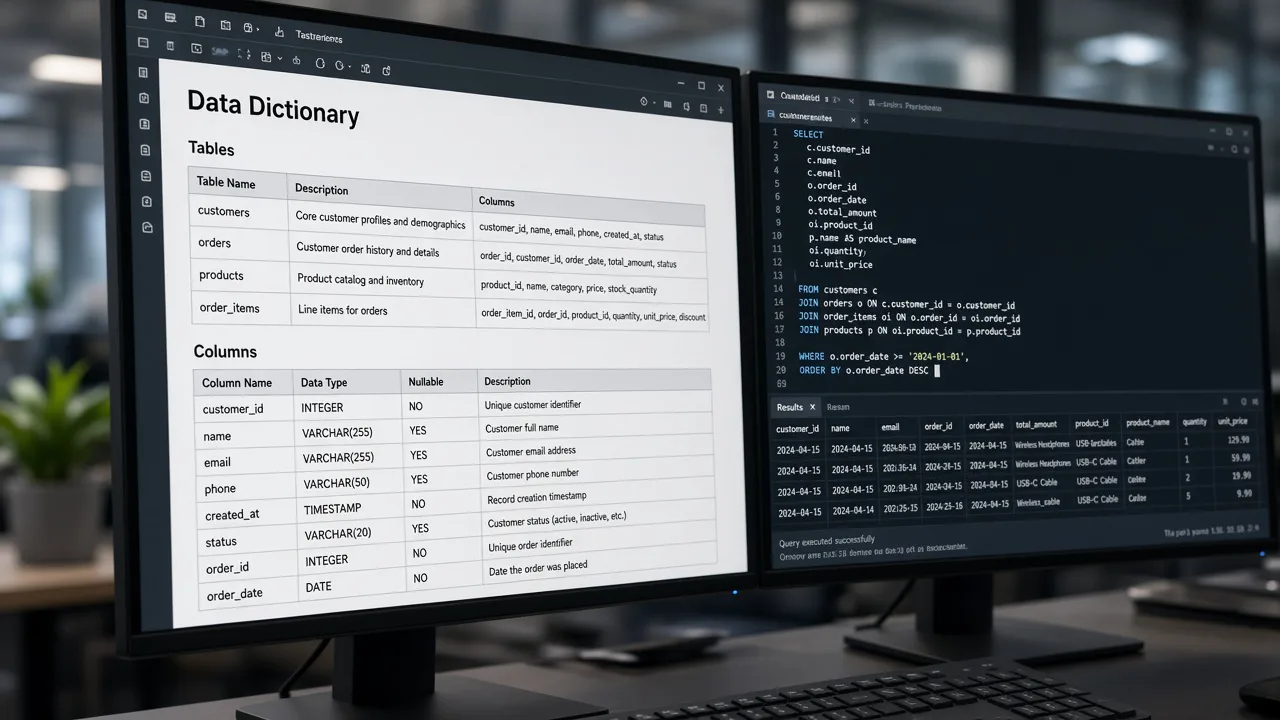
First establish a dictionary of standard definitions, then worry about making dashboards look good
The smallest closed-loop for data governance on the business side is:
- Metric definition: business meaning, numerator and denominator, time granularity, currency/tax-inclusive status, exclusion rules
- Version freeze: any changes to standards must follow version numbering; historical reports should be recalculable or marked with “old standard”
- Data access portal: single authentication query or semantic layer; direct connections to operational databases are prohibited and scattered access points must be eliminated
- Audit: who used which version of the standard to produce what figures, and when
Without such a dictionary, the middle platform will only turn into an even bigger data swamp. With a dictionary but no mandatory access controls, the dictionary becomes just decorative.
Design
Business owners define metrics; data stewards review feasibility; analysts only consume published metrics; finance retains veto power over legally mandated standards. Domain-specific governance (sales, inventory, funds) is separate, and cross-domain metrics must reference already-published atomic metrics.
- Metric attributes: code, name, standard documentation, owner, status
- Calculation logic: SQL/semantic expressions, dependency lineage
- Release version: effective date, change notes, compatibility strategy
- Consumers: reports, subscriptions, APIs, recording standard versions
When exporting meeting materials, automatically include the standard version number and refresh timestamp to prevent screenshots from being passed around by word of mouth.

Comparison: personal SQL vs. standard platform
| Dimensions | Individual data access | Standard dictionary + publication |
|---|---|---|
| Disputes | Arguing over definitions in meetings | Checking versions before discussing business matters |
| Changes | Quietly modifying SQL queries | Change orders + effective dates |
| Recalculations | Difficulties | Recalculating by version or marking accordingly |
| Permissions | Library account sprawl | Authorization at the metric level |
Implementation and acceptance
First govern the top 20 business metrics—don’t tackle the entire company’s metric library all at once. Each metric must have a business owner’s signature. After the semantic layer goes live, revoke read-only accounts in operational databases (exceptions require approval and are temporary).
Acceptance: verify whether two dashboards for the same metric show consistent numbers; check if old subscriptions prompt after standard changes; ensure that reports without version numbers cannot be externally shared (they shouldn’t); confirm whether lineage can trace back from reports to source tables.
The prerequisite for data intelligence is that numbers must be defensible. Precision that cannot be defended is just more expensive arguing.
Failure modes
Metrics with the same name but different meanings: mandatory unique coding, optional aliases for names. Analysts bypassing the semantic layer: audits reveal direct connections, leading to immediate revocation of permissions. No communication during standard changes: notify consumers via subscription updates, allowing a transition period.
What to watch after four weeks
Number of dispute tickets, duplicate metrics, direct database account counts, and interruptions in business meetings caused by “numbers not matching”—if these four metrics decline, expand AI-powered data assistants—though assistants must also only access published metrics and cannot freely generate unmanaged SQL.
Metric stratification: atomic, derived, thematic
Atomic metrics (such as order line amounts) are governed first; derived metrics (gross profit, conversion rates) declare dependencies; thematic metrics tailored to specific scenarios (e.g., cash collection health) are composed of atomic and derived components. Directly writing raw SQL to bypass the atomic layer for thematic metrics is prohibited.
Process for merging identically named metrics: retain the code, add aliases. Decommission obsolete metrics, taking them offline after consumer migration. Use lineage diagrams for impact analysis: changing one atomic metric can list all derived metrics and related reports.
When external regulatory standards coexist with internal management standards, use labels to distinguish them; meeting materials must clearly indicate which category is being used to avoid confusion.
The boundaries of AI-driven data access
Natural language queries can only search published metrics and controlled dimensions. If the model-generated SQL does not map to a metric code, execution is automatically rejected. Query logs are included in audits, facilitating replay of “which version of the standard was used at the time.”
Train business personnel to write “query scripts”: start with the metric code or standard name, then specify time and organizational scope. This approach is safer than letting the model guess “what kind of profit” is involved.
Data quality rules are attached to each metric: vacancy rate, fluctuation thresholds, reconciliation discrepancies. When quality flags light up, dashboards downgrade to “unavailable,” which is more responsible than displaying incorrect numbers.
Organizational implementation
The metrics committee doesn’t need to be large: one business owner, one data platform representative, and one finance officer suffice to make decisions. Escalation paths for disputes are codified in regulations to avoid endless arguments in group chats. Annually clear out zombie metrics and duplicate dashboards.
New dashboard proposals must reference existing metric codes; newly created metrics must explain why current ones aren’t sufficient. This approach is far cheaper than post-hoc governance.
Attach a one-page “standard footnote” to management reports: listing which metric codes and versions were used this quarter. During debates over numbers, refer to the footnote first, then discuss the business—avoid unnecessary table‑flipping.
Division of labor with reporting platforms
Reporting tools handle presentation and permissions; metric platforms manage definitions and versions. Dashboard authors choose metric codes but do not copy calculation formulas. If a report privately modifies formulas, the platform should flag it red and block its publication to the regular business meeting agenda.
Notification of metric changes via subscription: consumers (reports, APIs, email subscriptions) register their dependencies, and when standards upgrade, automatic notifications include change notes and deadlines for migration.
How to resolve metric disputes
Record dispute cases: submitter, current algorithm, requested algorithm, business scenario, list of impacted reports. After committee rulings, document version notes and effective dates; before decisions, freeze old versions in external materials and prohibit individual interpretations.
During financial closing periods, temporarily lock down standard changes; queue changes until the next open window. For urgent corrections outside the open window, use expedited channels and issue public announcements.
For metrics open to distributors or franchisees, assign separate namespaces to prevent leakage of internal management standards or misinterpretation as contractual terms.
Data audit export for internal review: who used which version of which metric to calculate which table, at what time. Combined with row-level permissions, prevent situations where standards are correct but data exceeds authorized limits.
The pilot departments should first ensure the dictionary and version freeze are functioning properly, then roll out the data query system company-wide; launching it for all employees at the same time would only exacerbate inconsistencies in terminology.
The version number of the standardized terminology should be included in the meeting minutes’ attachment name to minimize post‑event disputes.