In 2026, enterprise AI moves from proof-of-concept to production—but many pilots default to "full access": agents can query finance detail, HR payroll, and customer privacy. Demos dazzle; risk is extreme. Governable agents must enforce least necessary, auditable, and circuit-breakable design—otherwise one prompt injection can become a data incident.
Background: Good Results Do Not Equal Production-Ready
Teams often treat accuracy as the only metric while ignoring feature leakage, stale knowledge bases, and APIs saturated by agent concurrency. Open-source and commercial APIs must combine by scenario sensitivity; RPA suits repetitive clicks—agents handle judgment exceptions. Capabilities without owners quickly spin out of control in organizations.
Dirty data from entry, poor labeling, and training leakage from future information all cause cliff effects after launch. These are governance problems—not solved by swapping to a bigger model alone.
Core Method: Tier, Mask, Break, Review
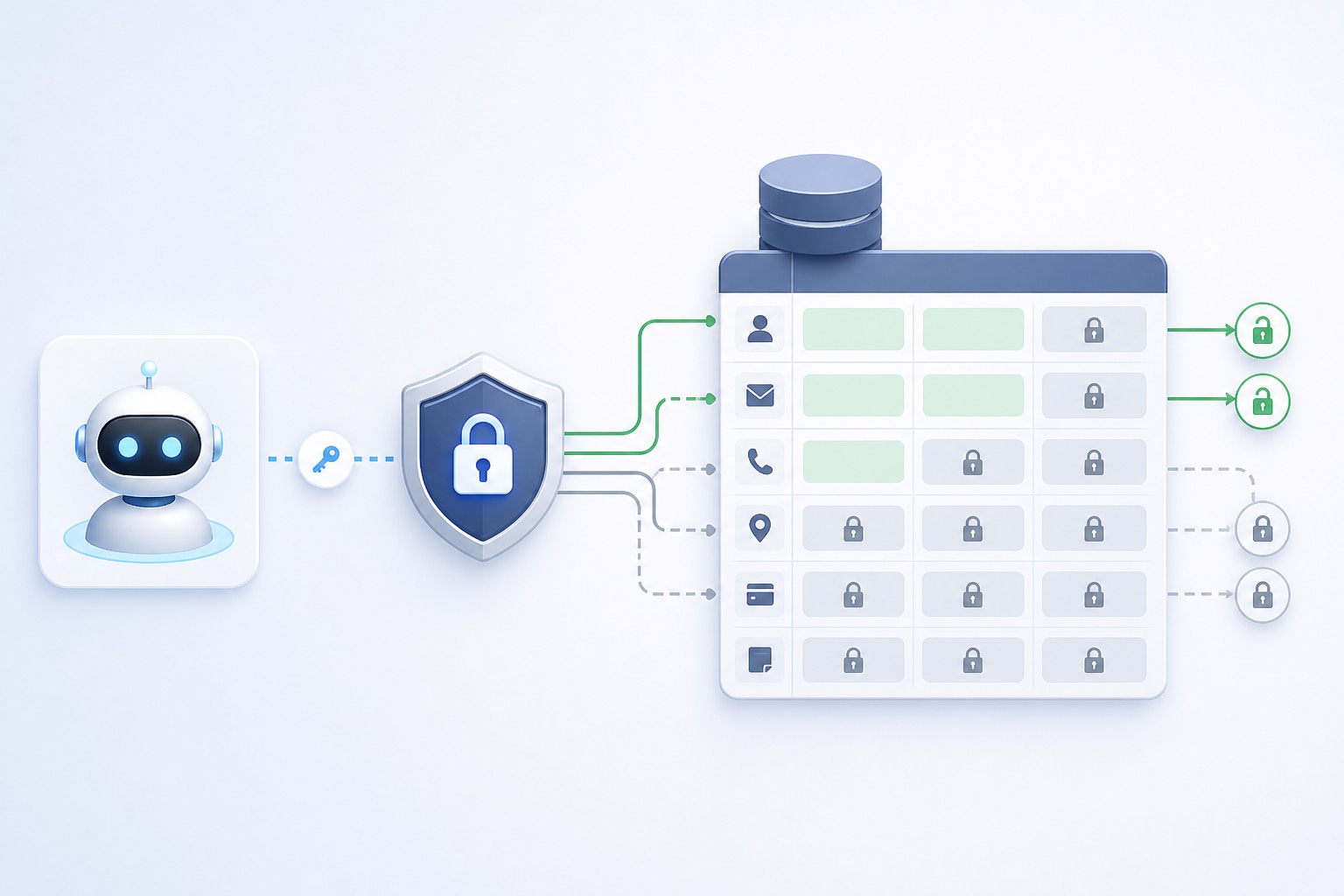
Permission Tiers and Field Masking
Grant tools by role and scenario: customer service agents must not default to payroll access; procurement agents must not export full pricing strategy. Sensitive fields show masked; write operations require second confirmation. Prompt-injection defense and over-privilege detection belong in the security baseline—not post-launch patches.
Audit and Failure Case Library
Every call logs input summary, tools used, results, and whether humans overrode. Misjudgments enter a failure case library—often more valuable than chasing new algorithms. Knowledge articles need owners and expiry dates; after policy updates, old PDFs must not remain authoritative in retrieval.
- Rate limits and circuit breakers on core transaction systems for agent calls
- Human sampling ratios may drop as accuracy rises—but sampling itself must never reach zero
- Business owns metric definitions; engineering owns pipelines; both reconcile together

Practice Case: Tiered Customer Service Agent Launch
One enterprise opened read-only order and logistics query tools first; finance and contract tools deferred. With rate limits, peak load no longer dragged down ERP. In two weeks, 120+ failure cases accumulated for weekly rule iteration. Accuracy rose while security audit proved controllable risk via sampling loops.
SME data stacks should stay lean: few components, strong definitions, exportable, auditable—reject unmaintainable platform stacks.
Before agents and ChatBI land, indicator dictionaries and data quality gates are mandatory. Front-end validation beats post-hoc cleansing teams; embedded analytics beat standalone data warehouse report piles. On security red lines, prompt injection and over-privilege tests belong in every release.
Talent division must be clear: business defines calibers, engineering owns pipelines, both reconcile. Without this split, stronger models only produce "confident wrong answers." Run governance first—then intelligence becomes repeatable enterprise capability.
As accuracy improves, human sampling can decrease—but the sampling mechanism itself stays as governance thermometer. Failure case libraries need regular review driving rule updates, not archive-only storage. This is the key flywheel for sustained enterprise intelligence evolution.
Summary and Outlook
Production-grade enterprise agents put permissions and audit before prompts and models. Make least-necessary data and failure review institutional—then AI moves from report stacking to governable decision loops. When connecting ERP execution agents next, apply the same tiering and circuit-breaker principles.