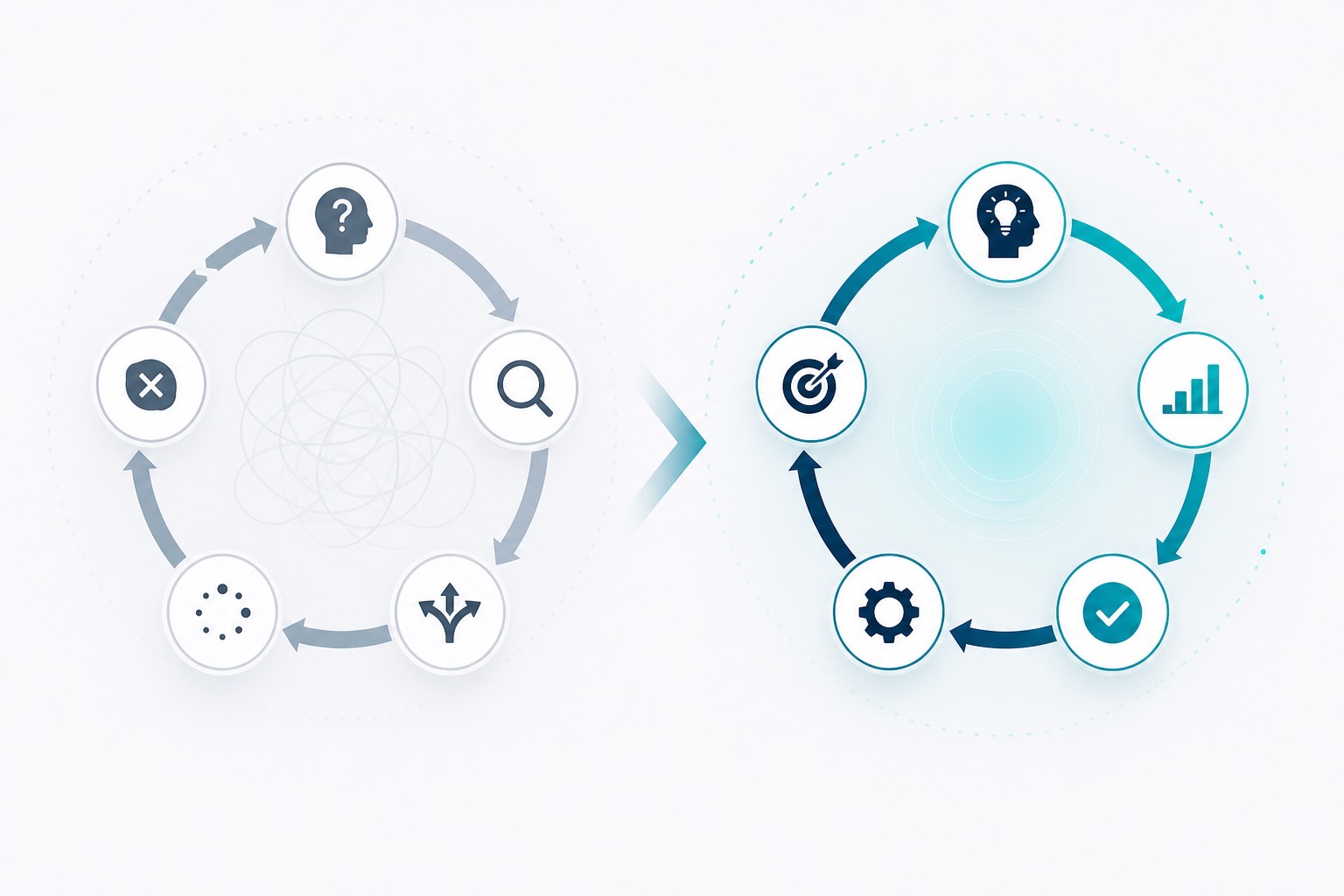
Many digital intelligence projects ship complete feature lists yet cannot answer the boss's core question: are decisions faster, more accurate, and less coordination-heavy? Acceptance that only checks module go-live produces five types of fake progress: more reports nobody uses, connected interfaces with conflicting definitions, lively pilots that do not scale. With 2026 budgets tighter, ROI must be written as verifiable business outcomes.

Background: System Build Does Not Equal Capability Formation
Research and enterprise surveys repeatedly show a gap between technology availability and deep application—only a small share of enterprises achieve deep application in core business. Meanwhile, on the eve of large-scale AI adoption, over 40% of enterprises that have tried AI remain in exploration. Buying systems or models does not automatically improve operations.
Fake progress shares one trait: no baseline comparison. Decision time before and after go-live, shortage frequency, and collection cycles are not measured—so value cannot be proven and the next investment cannot be decided.
Core Method: Pilot Design That Shows Results in Three Months
Pick High-Frequency, Measurable Scenarios with Owners
Pilots should meet three tests: occurs dozens of times per week, results are quantifiable, and a clear business owner exists. Examples: kit completeness checks, quote version approval, accounts-receivable follow-up. Avoid starting with a broad "business brain." When XYN Technology serves growing enterprises, it prioritizes scenarios with baseline comparison within three months, then expands to intelligent-agent auto-execution.
Write Acceptance Criteria in Business Language
Examples: kit first-pass rate rises from 62% to 80%; average quote approval time drops from 3 days to 1; exceptions escalate and close inside the system—not via private WeChat. Software price is the cost side; decision cycle and error cost are the benefit side.
- Freeze baseline data in the project kickoff week
- Publish weekly pilot dashboards—zero tolerance for fake activity
- In retrospectives, separate product issues from organizational incentive issues
Case Study: Cycle Change from Approval-Flow Reform
A foreign-trade manufacturer had more than ten approval nodes. The reform did not remove control—it introduced limits and exception mechanisms: auto-pass within limits, exceptions to sampling and audit. After two months average approval time fell by more than half with no rise in violations. ROI narrative shifted from "we deployed OA" to "order commitments arrive faster."
Entry points differ by industry: manufacturing focuses on scheduling and quality; foreign trade on documents and delivery; services on project closure and collection. One-size templates most easily create fake progress.
At the organizational level, digital intelligence projects must align incentives explicitly: if business KPIs still reward only short-term shipment, nobody invests time in master-data governance. Write pilot metrics into department goals and compare openly in retrospectives. When choosing vendors, delivery capability and scenario depth matter more than quote sheets—whether they can co-run three months often decides whether results appear.
For legacy systems, full replacement is not required first. Interfaces and master data can revitalize old systems; intelligence sits on the collaboration layer. ROI arrives faster and transformation risk is lower—matching the "small, fast, light, precise" first-year route for growing enterprises.
Summary and Outlook
Digital intelligence must shift from system building to outcome management. Writing decision-cycle shortening into acceptance filters scenarios worth scaling and builds a credible data foundation for later AI Agent auto-execution. When applying intelligent agents next, measure success by business outcomes—not conversation counts.