News

Industry insights, case studies, and the latest updates.

Store inspections are just for show: How can store visits, corrective actions, and follow-up inspections form a closed loop?

Store inspections are just for show: How can store visits, corrective actions, and follow-up inspections form a closed loop?

Common challenges in chain-store inspections: photos posted to group chats receive no response, paper inspection forms consistently report everything as compliant, and no one follows up on corrective measures. This article proposes a four‑step closed-loop model—planning, execution, correction, and re‑inspection—explains key design elements such as an inspection checklist template library, standardized scoring criteria, issue tracking records, and an escalation mechanism, and

Read More

Dealers rely on phone calls and spreadsheets for ordering, rebates, and reconciliation: How can channel collaboration be brought into the system?

Dealers rely on phone calls and spreadsheets for ordering, rebates, and reconciliation: How can channel collaboration be brought into the system?

Daily collaboration between manufacturers and distributors heavily depends on WeChat groups and Excel: order transcription is prone to errors, rebate policies lack uniformity, and reconciliation cycles can stretch for several weeks. This article breaks down three critical pain points in channel operations—ordering, policy management, and reconciliation—proposing a system design featuring an ordering portal, a policy engine, and automated reconciliation statements. It also

Read More
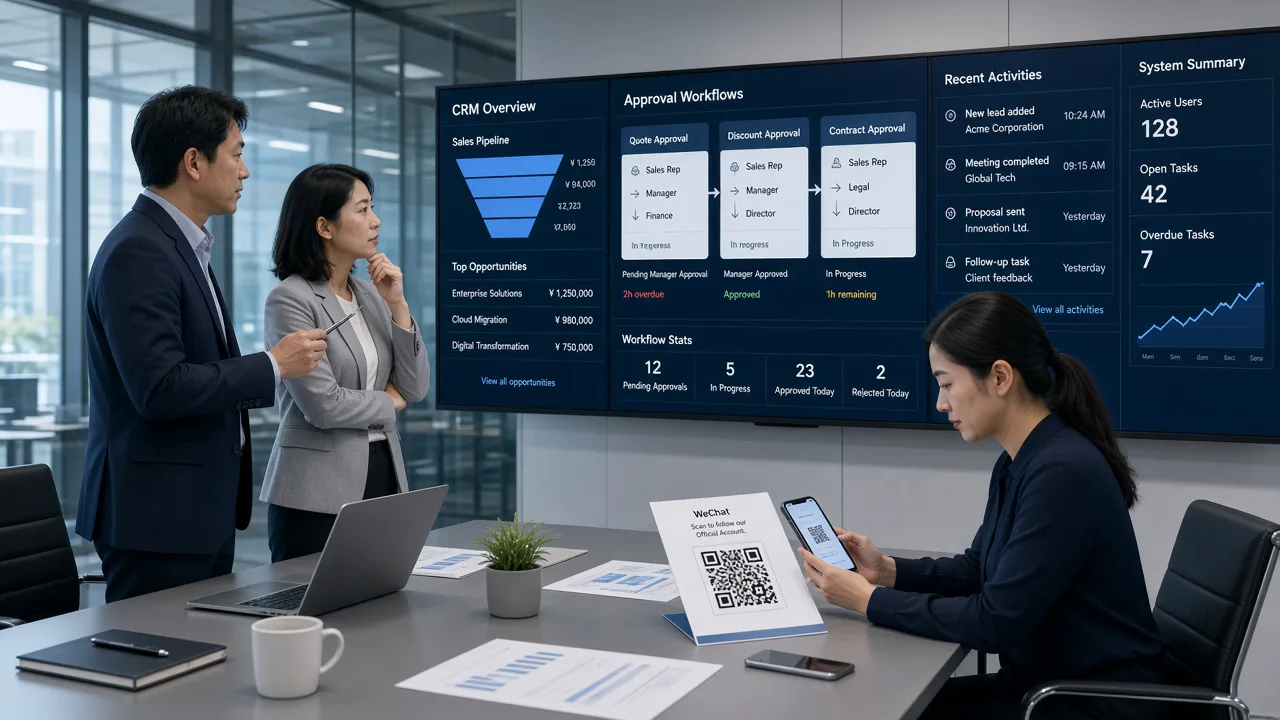
Approval relies on WeChat groups: how to turn approval workflows, official documents, and organizational permissions into a system

Approval relies on WeChat groups: how to turn approval workflows, official documents, and organizational permissions into a system

Approval depends on WeChat groups, finding people requires asking around, and auditing hinges on screenshots. The article breaks down OA into three layers—tasks, processes, and data—clearly explaining dynamic nodes, three-tiered permissions for menus/data/fields, and the implementation paths for the three engines of process, form, and messaging.

Read More